
How to Search Criminal Dockets
Missouri Case.net is the free statewide place to start a Cooper County criminal docket search. Have a number from a citation or notice? Case Number Search is the fastest route. Without one, try Litigant Name Search. Bear in mind that a blank result does not prove no case exists, since protected people and non-litigants may simply never appear in a name search.
Before trusting a hit as the right Cooper County case, match more than the name. The division, case category, filing date, status, next setting, and latest docket entry all help. Even then, a public result is only an index and a chronology. No rule promises that every document or attachment will open remotely.
- Open Case.net and choose Case Number Search if a Cooper County notice gives a complete number.
- Otherwise use Litigant Name Search and narrow to Cooper County or the 18th Judicial Circuit when that choice is offered.
- Compare the court, category, party role, and filing date before opening the case detail.
- Read the latest criminal docket entries and the next setting, then preserve the exact case number for any clerk contact.
- Call the Circuit Clerk if the public docket is unclear, an attachment is unavailable, or a copy is needed.
Cooper County Criminal Case Number Clues
Missouri Court Operating Rule 4.04 governs the format. An automated case number opens with a two-digit year. Then comes a location code, a two-letter category, a five-digit sequence, and a two-digit subcase. For a criminal matter, that category reads CR. Some numbers add a division or subtype suffix. An X can flag a bound-over, trial-de-novo, or full-circuit matter.
Municipal and traffic filings send different signals. MU marks a municipal ordinance category. MT and MO show up in municipal traffic or ordinance formats. Older manual numbers follow their own pattern entirely. Keep every number from a citation, transfer order, notice, or clerk receipt. A transferred case can get a brand-new number.
Note: The category the court displays beats any guess built from a charge description or a city name.
What a Criminal Docket Shows
Court Operating Rule 4.08 sets what a docket must hold. The list includes the filing county or city, case type, case number, parties, attorneys of record, document dates and types, and judicial actions such as orders and judgments. Beyond that baseline, a Cooper County criminal docket may list more. Entries can include a charge or count, bond or release entry, arraignment, motion, hearing, plea, disposition, sentence, compliance review, warrant activity, or appeal notation when public.
Read the wording with care. A charge stays an allegation until the case has a public disposition. A calendar line only shows a scheduled event, not proof it happened. And a judgment entry can signal an outcome even when the signed document itself stays out of reach. The current access level decides that.
| Court and division | Cooper County, the 18th Judicial Circuit, and the division displayed for the case. |
|---|---|
| Case number | The complete court identifier, including a CR, municipal, or older-format category where shown. |
| Charge and filing | The public charge text, count, charging document, and date entered on the docket. |
| Settings and motions | Arraignment, pretrial, trial, motion, reset, response, ruling, and next-setting entries. |
| Disposition and sentence | The exact public result and any docket-level sentence or final-order notation. |
| Document access | A hyperlink, no link, redaction, seal, or other limit on an attached electronic document. |
Cooper County Criminal File Viewer Access
Why does a Cooper County criminal docket sometimes show more than a remote viewer will deliver? The state's File Viewer help answers that directly. A hyperlink usually means an electronic document is attached. An entry with no link can mean there is no attachment. It can also mean the current viewer cannot reach it. An ECASE label tells you the case is electronic rather than a paper file.
The official File Viewer materials also cover courthouse public-access terminals. There, staff may log a public user in to view public documents. That route is the practical fallback when a docket entry needs a file-access answer. Still, it overrides nothing. A seal or confidential category holds firm.
Missouri's public File Viewer guidance lays out electronic-case access and document links.
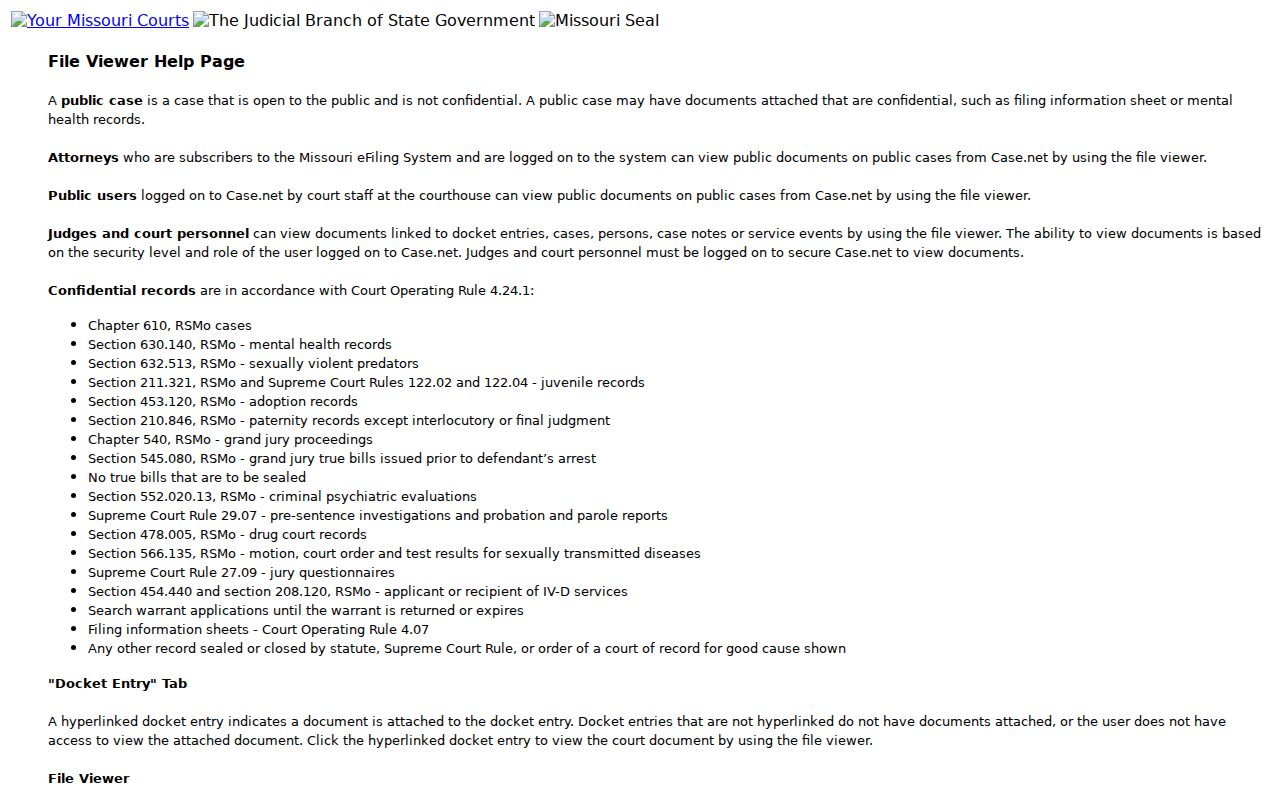
Finding a Cooper County criminal docket and pulling a document from the court file are two different steps. The viewer makes that gap plain.
Stages on a Criminal Docket
Most Cooper County criminal docket entries follow a familiar arc. A filing or citation starts it. Then comes an arraignment or first appearance. Pretrial settings and motions follow, then a plea or trial, a disposition, and sentencing or a final order. After that, post-judgment review, payment, probation, appeal, or closure may follow. Real cases wander, though. Stages combine, and continuances pause the calendar. Transfers move the file, and some charges carry their own rules.
Docket flow: Filing or Citation › Arraignment or First Appearance › Pretrial Settings and Motions › Plea or Trial › Disposition › Sentencing or Final Order › Post-Judgment Activity
Each line carries limited meaning. A "continuance" or "reset" only tells you the event moved to a new date. "Disposition" is the result the court entered. Exact wording matters most near the end of a Cooper County criminal docket, where a result, warrant notation, or compliance review can look similar at a glance.
Cooper County Criminal Docket Terms
Court Operating Rule 4 makes the docket sheet or backer sheet, along with filed documents, part of the official court record, subject to exceptions. That makes the docket a solid chronology. It is still not a finding that each allegation is true, nor a substitute for the signed document itself.
- Arraignment
- An early criminal appearance that addresses the charge and a plea or next step.
- Disposition
- The result or resolution shown by the court for a charge or case.
- Continuance
- A proceeding or date moved to another setting, also called a reset.
- Backer sheet
- Missouri’s term for a docket sheet or case-cover chronology within the official record definition.
The Rule 4 recordkeeping source defines the docket fields and access limits described here.
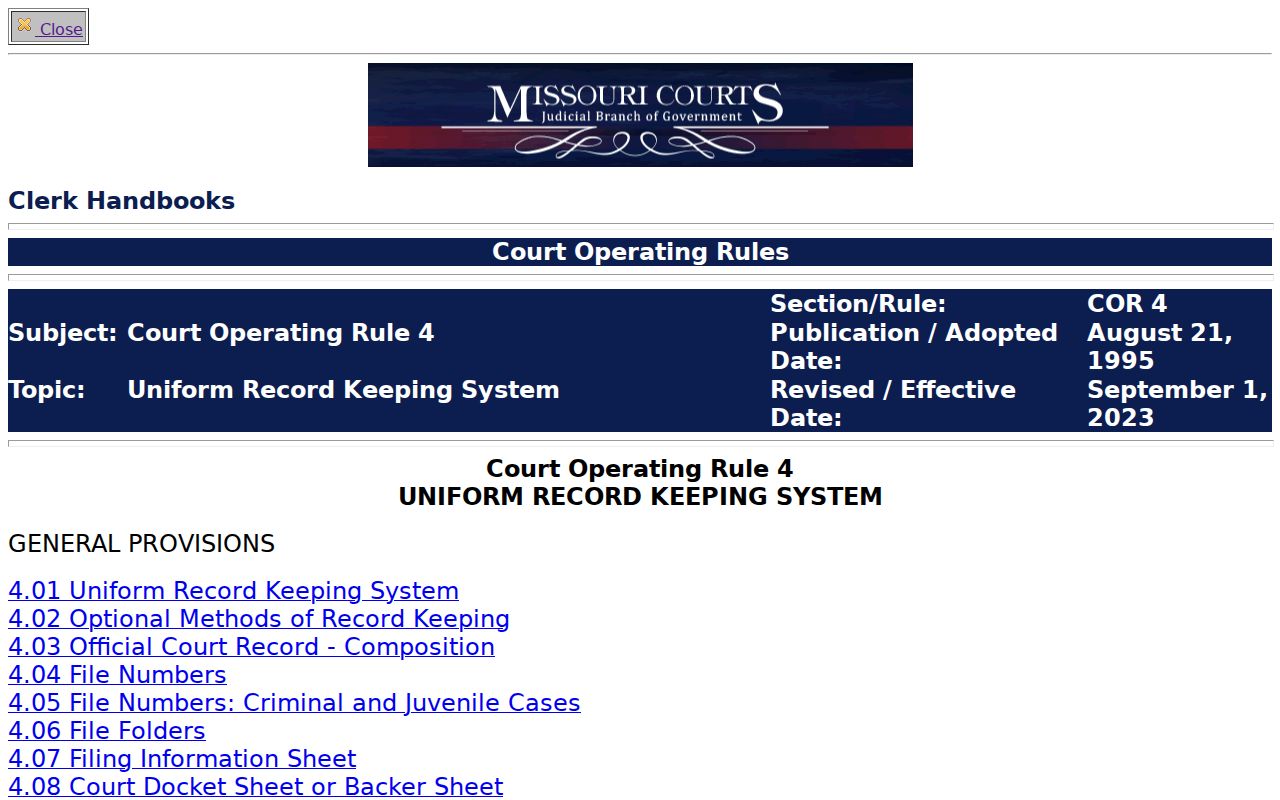
Rule 4 is the statewide framework behind every Cooper County criminal docket entry.
Which Court Holds Criminal Dockets
Felony and misdemeanor cases in Cooper County belong to the Circuit Court of Missouri. That is the 18th Judicial Circuit. Division 1 is the Cooper circuit division on the local court map. Division 3 handles the associate division. Criminal and traffic work runs through the Circuit Clerk. The county's own Circuit Court office explains it.
Which division owns a case depends on the charge, any transfers, and standing court orders. So trust the division printed on your notice or your Case.net result. Guessing the court from the offense alone can send a docket search in the wrong direction. That wastes time with the wrong clerk.
Cooper County Municipal Criminal Transfers
Cooper County has no countywide docket for city cases. Each town runs its own municipal court, and the 18th Circuit local rules lay out the lineup: Boonville Division 18, Otterville Division 13, Bunceton Division 14, Pilot Grove Division 15, Blackwater Division 16, and Prairie Home Division 17. Things shift when a case grows. A municipal matter can move up to an associate or circuit division, and it gets a new case number in the process. Keep both numbers handy when that happens.
Windsor Place is a helpful boundary to know about. Its official court information ties it to the Cooper County Associate Circuit Court. If you hold a Windsor notice, save the citation plus any later court number, then verify the division with the Circuit Clerk rather than hunting for a standalone city search system.
Cooper County Criminal Clerk Route
For a Cooper County criminal docket, go to the Circuit Clerk. Not the County Clerk. The County Clerk's own records guide points court-record requests straight to the Circuit Clerk. That settles the question. The distinction matters most when a criminal docket shows a missing attachment or an unclear setting. It also matters when you need a plain or certified copy of a filing.
Cooper County Circuit Clerk
Nancy Fisher
200 Main Street, Room 31
Boonville, Missouri 65233
660-882-2232
Monday through Friday, 8:30 a.m. to 5:00 p.m.
Payment for copies is cash, cashier's check, money order, or credit card. Personal checks are not accepted. Ask the county court office about the current amount and method before you request a copy.
Public Access and Sealed Criminal Dockets
Missouri court records stay open during regular business hours unless a statute, rule, or order closes them. That presumption has limits, though. A public Cooper County criminal docket can still carry redacted entries, a confidential attachment, or a paper only the clerk may evaluate. Open does not mean everything is visible.
Court Operating Rule 4 spells out what stays off limits: presentence reports, criminal psychological evaluations, grand-jury material, certain warrant records, victim-identifying information, and anything a law or order makes confidential. Sealed records open only with a court order. Expunged records go to authorized people alone. They are not simply wiped from every court system.
Key Rules:
Missouri Revised Statutes, Section 610.011 states Missouri’s open-record policy and liberal-construction rule.
Missouri Revised Statutes, Section 509.520 protects specified personal data in court filings through redaction rules.
Missouri Revised Statutes, Section 211.321 generally makes juvenile records confidential, subject to stated exceptions.
Missouri’s juvenile-record statute explains why a Cooper County criminal docket search can come up short on some matters.
That statute draws the access line. Even a public Cooper County court docket stops where juvenile confidentiality begins.
Cooper County Criminal Search Limits
Start with the exact case number. If a known Cooper County criminal case still will not appear, call the Circuit Clerk. Keep the notice details in hand. A matter can be new, older, transferred, or disposed. It might sit in a nonparticipating municipal system. It might also be restricted. Case.net also runs maintenance Monday through Friday from 1 a.m. to 6 a.m. Central Time, so a maintenance message tells you nothing about whether the case exists.
A courthouse terminal can open public material that an unauthenticated remote search hides. It cannot break a seal. Ask the clerk which access category applies. Ask also whether a public copy, certification, or different request would help.
Note: Keep the docket wording exact when you ask about a status, a setting, or a document. Small label differences can matter.